
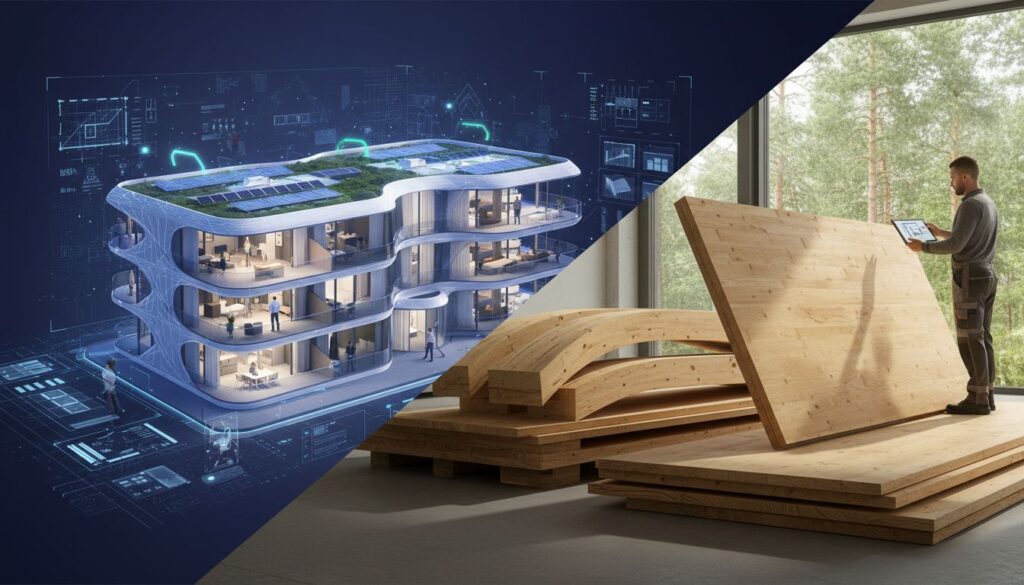
Property storytelling is changing fast: buyers and investors now expect both a vivid digital preview and a credible sustainability narrative. The most effective stories are no longer built on a few photos and a brochure,they’re built on measurable space, immersive experience, and defensible material decisions.
Two forces are converging. First, immersive 3D showrooms and tours are becoming the default way to understand a place before a visit. Second, low‑carbon timber is moving from “nice-to-have” to a strategic lever in net‑zero pathways,bringing embodied-carbon data, certification, and carbon storage claims into mainstream conversations.
1) From static listings to immersive, decision-ready narratives
Real estate marketing has historically been a translation exercise: turning a three-dimensional, sensory experience into a small set of images and a floorplan. That approach worked when buyers had limited choice and low expectations for digital tools. Today, it often underserves the way people actually make decisions,by exploring layout flow, light, adjacencies, and how spaces support everyday routines.
Immersive 3D showrooms change the sequence of understanding. Instead of reading about “open plan living,” viewers test it: they move from kitchen to dining to terrace, check sightlines, and notice pinch points. For architects and developers, this means the story becomes spatial and experiential rather than purely descriptive.
It also reduces ambiguity. A well-structured 3D tour paired with an accurate, interactive floor plan can clarify what a photo cannot: ceiling height transitions, threshold moments, storage depth, and circulation. In practice, this improves qualification,serious viewers arrive with more informed questions, and unsuitable buyers self-select earlier.
2) 3D tours are now mainstream expectations,not a premium extra
Buyer demand for immersive content has crossed into “baseline expectation.” Zillow’s 2025 Consumer Housing Trends Report for Agents shows agreement with “I wish more listings had 3D tours available” increased from 46% in 2019 to 65% in 2025,the highest point in that series. That shift matters: it signals that 3D is increasingly evaluated like professional photography rather than a novelty.
Adoption is also visible on live listings. In Q2 2026, Zillow reported its rich media products,such as 3D Home tours and interactive floor plans,appearing on 11% of new for-sale listings, with its paid Showcase product on about 5% of all new listings. Those numbers indicate momentum, but they also imply a competitive advantage for projects that use immersive media well: many listings still don’t.
For property owners and agents, the implication is practical: “having a 3D tour” is not the end goal. The goal is to use immersive storytelling to reduce uncertainty,about scale, layout, and potential,so the buyer can progress with confidence. Quality of capture, accuracy of measurement, and clarity of navigation now define whether a 3D tour actually performs.
3) Virtual viewings are influencing outcomes, not just awareness
Immersive content is moving beyond marketing metrics into transaction reality. Mark Studios’ 2026 summary of NAR data notes that 5% of buyers in August 2026 purchased based on a virtual tour, showing, or open house without ever physically visiting the property. That’s a small share, but significant,because it proves that virtual experiences can carry enough trust and detail to support high-stakes decisions.
In residential projects, this is especially relevant for relocations, international buyers, and time-compressed purchases. It also impacts refurbishment and design-led repositioning: when a property has been thoughtfully optimized, a 3D-first narrative can help buyers understand “why the plan works” before they arrive on site.
For developers and design teams, the opportunity is to align the digital experience with the real one. Measured surveys and correct geometry are foundational here: if a 3D showroom exaggerates proportions or hides awkward transitions, the story collapses during due diligence. Precision is what turns immersive viewing from entertainment into decision support.
4) Immersion as asset strategy: place-making, destination logic, and “retailtainment”
Immersive storytelling is not limited to homes. JLL’s 2026 global outlook suggests value will concentrate in cities that can deliver appealing immersive experiences,framing immersion as a place-making and asset strategy rather than a short-term marketing trick. This broadens the meaning of “showroom”: it becomes a lens for how people discover, understand, and emotionally connect with a district, building, or brand.
Adjacent sectors reinforce the commercial logic. Gensler’s 2025 Immersive Entertainment & Culture Industry Report found 73% of audiences were willing to travel for immersive experiences they liked. That willingness to travel underlines why story-led environments matter to mixed-use and hospitality projects: experience can be the demand engine.
Retail real estate is already adapting. JLL notes entertainment concepts,Netflix House, challenge rooms, immersive art, and competitive socializing,taking large footprints in malls and lifestyle centers. CBRE’s 2025 U.S. real estate outlook labels “retailtainment” as a market trend, combining shopping with dining, entertainment, and activities to create more immersive brand engagement. Property storytelling, in this context, is about curating an experience ecosystem,and using digital immersion to preview it.
5) Low‑carbon timber: a material story that’s becoming policy-backed and data-led
As immersive media expands, sustainability claims are being scrutinized more closely. Low‑carbon timber is increasingly positioned as a net‑zero construction lever, with the UK government’s 2025 timber roadmap advocating timber as a safe, high-performing material supporting net zero alongside other low-carbon products and a circular economy. This matters for storytelling: the narrative is shifting from “timber is warm and natural” to “timber is performance + carbon strategy.”
Policy support is strengthening elsewhere too. Ireland’s government described the Timber in Construction Steering Group report as a “significant milestone” toward a low-carbon, resilient built environment. For developers and specifiers, this creates a clearer runway for timber adoption,reducing perceived risk and supporting long-term investment narratives.
Market estimates suggest real scale potential. Ireland’s timber sector opportunity report estimated the 2025 baseline timber construction market at almost 670,000 cubic metres valued at about €180 million, with an accelerated scenario reaching 1.85 million cubic metres and delivering substantial avoided carbon. That kind of quantified growth story is increasingly part of how projects secure buy-in from stakeholders who need numbers, not just intent.
6) Turning embodied carbon into a clear, credible narrative
Material storytelling is becoming more evidence-based, particularly around embodied carbon. Timber Development UK’s 2026 embodied-carbon update is an example of how the industry is equipping designers to compare carbon impacts across material choices. In practice, this enables clearer client conversations: not “timber is greener,” but “here’s how the embodied-carbon profile changes if we choose X vs Y.”
Certification is also becoming part of the story’s backbone. PEFC notes that LEED v5 updates allow PEFC-certified wood and paper products to achieve LEED credits, strengthening demand for responsibly sourced timber in low-carbon buildings. For property owners and teams preparing sales packs, this means the narrative can link material choice to recognized verification pathways,reducing greenwashing risk.
Some projects now market timber through carbon storage claims. A 2026 Swinerton project in Austin states its timber structure stores the equivalent of about 500 metric tons of carbon dioxide. Used responsibly, this kind of claim can help non-specialists understand why timber matters,provided it’s presented with context, boundaries, and the broader whole-building carbon strategy.
7) Where immersive 3D showrooms and timber narratives meet
The most compelling property storytelling now connects experience to evidence. Immersive 3D showrooms make design intent legible,how daylight moves across a living space, how a stair becomes a social anchor, how storage supports calm. Low‑carbon timber adds a parallel layer: why the material palette supports health, longevity, and climate goals.
This is also consistent with how consumers engage with interactive planning tools more broadly. A 2026 3D Cloud furniture-shopping study summary reported that 3D visualization is increasingly important in consumer decisions, driving engagement and satisfaction through interactive planning. The lesson for property is straightforward: interactivity builds confidence, and confidence supports commitment.
In practical terms, digital environments can “show the carbon story” without overwhelming the viewer. Examples include optional hotspots that explain timber sourcing and certification, toggles that compare material alternatives, and overlays that connect structural choices to spatial outcomes (spans, column grids, ceiling expression). The result is a narrative that is both emotional (how it feels) and rational (why it performs).
8) Practical ways to build a stronger, lower-carbon property story
Start with measured truth. Accurate measured surveys and well-structured floor plans prevent the most common storytelling failure: mismatch between the digital promise and the physical reality. When immersive 3D showrooms are grounded in correct geometry, they become reliable tools for planning, budgeting, and decision-making,not just marketing assets.
Design the tour like a guided conversation. Lead with the moments that express value: arrival sequence, connection to outdoor space, flexible rooms, and storage. Then add depth: interactive floor plans for orientation and optional layers for refurbishment ideas, staging options, or alternate layouts. This approach respects different audiences,buyers want clarity, while professionals want detail.
Make sustainability legible and verifiable. If low‑carbon timber is part of the design, articulate it with data, certification, and boundaries: what is specified, what standard it meets, and how it fits within the whole project’s carbon strategy. Where carbon storage or avoided-carbon figures are used, present them carefully, citing assumptions and avoiding simplistic comparisons.
Property storytelling is moving toward a new standard: immersive, measurable, and accountable. Zillow’s data shows that 3D tours have become a mainstream expectation, while transaction behavior and global outlooks indicate immersion is increasingly tied to real outcomes,whether closing deals remotely or supporting place-making strategies.
At the same time, low‑carbon timber is reshaping what a “good story” looks like, supported by policy signals, market scaling potential, embodied-carbon updates, and stronger certification pathways. The projects that stand out will be those that unify these threads,pairing immersive 3D showrooms with credible low-carbon narratives,so people can not only imagine the space, but also trust the substance behind it.