
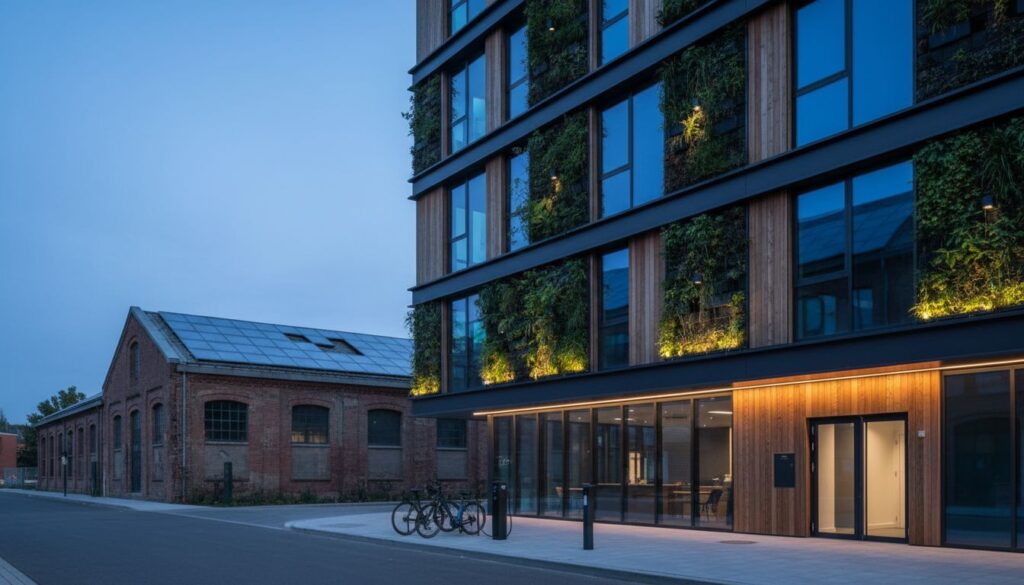
Across global climate policy, the direction of travel is becoming clearer: the lowest-carbon building is often the one that already exists. In 2026, urban climate plans, city mandates, and building policy frameworks are placing far greater emphasis on retrofit, adaptive reuse, and the careful upgrade of existing stock. For architects, developers, and property owners, this is more than a sustainability narrative. It is a practical shift in how projects will be planned, financed, approved, and delivered.
That shift matters because low-carbon urban retrofits sit at the intersection of policy, market demand, and technical execution. Measured surveys, precise floorplan analysis, phased renovation strategies, visualization tools, and material choices all become more valuable when regulations increasingly reward retention over replacement. As cities move from pilot schemes to mainstream retrofit programs, design teams that can quantify existing conditions and unlock reuse potential are well positioned to lead.
Urban climate policy is putting existing buildings at the center
Recent climate planning signals show that cities are no longer a secondary layer within national climate action. UN-Habitat’s Urban Content in NDC 3.0: Cities at the Centre analyzes 142 third-generation NDCs submitted by mid-April 2026 and finds a stronger role for urban policy in national climate plans. That matters for the building sector because urban emissions, urban resilience, and urban growth management are increasingly being addressed together rather than in isolation.
For the built environment, this emerging policy logic favors low-carbon urban retrofits over carbon-intensive demolition and rebuild. Existing buildings represent both a constraint and an opportunity: they are where energy inefficiency, material waste, vacancy, and resilience risks are concentrated, but they are also where cities can move fastest. Compared with waiting for new-build stock to gradually improve, upgrading what is already standing can produce immediate carbon and social benefits.
UN-Habitat’s 2025 guidance also underscores why this matters now. It notes that only 27% of NDCs include strong urban content and only 40% include both urban mitigation and adaptation strategies. Retrofit and adaptive reuse help close that implementation gap because they translate climate targets into place-specific action, from energy upgrades and heat resilience to housing conversion and public asset renewal.
Adaptive reuse is becoming a climate strategy, not only a design choice
Adaptive reuse has long been associated with heritage preservation or creative urban regeneration, but the policy framing is expanding. UN-Habitat’s 2026 World Cities Report describes underutilized building stock as a climate opportunity and says mobilizing that stock “through adaptive reuse or vacancy regulation” offers an immediate, climate-smart path for urban development. In other words, reuse is now being positioned as a direct emissions and land-use strategy.
This changes the project conversation for commercial, residential, and mixed-use assets. A partially vacant office building, an obsolete industrial structure, or an underperforming civic property can now be evaluated not only for financial uplift, but also for carbon avoidance, resilience value, and policy alignment. Reuse keeps structural systems, embedded materials, and urban infrastructure in service for longer, reducing the emissions impact that typically comes with clearance and full replacement.
Market practice is following the same path. C40’s 2025 Clean Construction reporting highlights Los Angeles expanding its Citywide Adaptive Reuse Ordinance to incentivize conversion of commercial buildings into housing. That kind of policy mechanism signals a broader trend: adaptive reuse is becoming easier to justify when it helps cities address emissions, housing demand, and land efficiency at the same time.
Whole-life carbon is reshaping decisions about demolition, materials, and scope
One of the most important policy shifts is the move from operational carbon alone to whole-life carbon. C40 notes that embodied emissions from materials and demolition now make up a growing share of a building’s total carbon footprint. As operational performance improves through better systems and cleaner grids, the carbon cost of tearing down and rebuilding becomes more visible and harder to defend.
For project teams, that means early-stage decisions carry more weight. Whether a structure can be retained, how much of the envelope can be upgraded, which interior elements can be reused, and where low-carbon materials can substitute conventional ones all influence whole-life performance. Low-carbon urban retrofits therefore require more than energy modeling; they require accurate existing-condition data and coordinated design decisions across architecture, engineering, and procurement.
The IEA’s 2026 Energy Efficiency Policy Toolkit reinforces this direction by recommending that renovation policy include CO₂ performance requirements for both construction and operation. It also points to building codes as instruments that shape how buildings are “designed, constructed, operated and renovated.” That wording is significant. It confirms that codes are increasingly intended to govern renovations as seriously as new buildings, embedding energy efficiency, circularity, and low-emissions practices across the full building life cycle.
City mandates and ordinances are moving retrofits into the mainstream
Policy momentum is no longer limited to voluntary guidance. C40 reports that 78% of signatory cities run retrofit programmes for existing buildings, a clear sign that retrofit has moved beyond isolated demonstration projects. In parallel, 70% of signatory cities have set energy regulations for buildings and are aiming for net-zero carbon by 2030. This indicates a broad transition from encouragement to structured compliance and performance management.
Tokyo provides a strong example of how city policy can shape delivery. According to C40, from April 2025, suppliers providing at least 20,000 square meters of floor space annually in Tokyo must meet a new building mandate, alongside support for solar and low-emission appliances. Measures like this influence both new supply and the retrofit market by changing expectations around building performance, equipment, and portfolio strategy.
Public-sector roadmaps are also helping normalize retrofit as an ongoing civic obligation rather than a one-off climate initiative. Guadalajara’s 2025 climate action update included a Roadmap for Existing Net Zero Carbon Public Buildings by 2050 and an energy-efficient public procurement manual. For private owners and investors, these moves signal where standards, benchmarking expectations, and competitive norms are ing.
Procurement and public investment are becoming decisive policy levers
Procurement is emerging as one of the most practical tools for accelerating low-carbon urban retrofits. C40 recommends that cities use purchasing power to demand low-carbon construction materials and practices. This matters because procurement can influence real project outcomes immediately, even before every regulation or code is fully updated. If public clients ask for reuse assessments, carbon reporting, circular material strategies, and resilient upgrade pathways, the market adapts quickly.
For design and development teams, this increases the value of evidence-based project preparation. Measured building surveys, verified floor areas, existing-asset inventories, and scenario testing become essential inputs when public or institutional clients need to compare reuse, refurbishment, and redevelopment options. Clear 3D visualizations and phased retrofit plans can also support approvals, procurement submissions, and stakeholder alignment, particularly on complex occupied sites.
Procurement-led change is also likely to influence private projects through supply chain normalization. Once low-carbon materials, circular specifications, and renovation-focused delivery models are demanded at scale, costs and capabilities improve across the market. That creates a reinforcing cycle in which policy not only mandates outcomes but builds the commercial conditions needed to deliver them.
Retrofit policy is expanding from energy efficiency to resilience and neighborhood transformation
Urban retrofit is no longer framed solely as a matter of reducing energy use. UN-Habitat’s 2026 Urban Climate Resilience and the Law was developed to support Costa Rica’s adaptation construction code, showing how legal frameworks are evolving to support climate-resilient urban buildings. This broadens the retrofit brief to include overheating risk, flood response, material durability, passive survivability, and public health.
The IEA also emphasizes that national and city-level alignment in energy efficiency policy is a key dimension of clean energy transitions. That alignment becomes more effective when retrofit strategies address both mitigation and adaptation. A building upgrade that cuts energy demand but ignores heat stress, water management, or aging infrastructure may quickly underperform in practice. Resilience-led retrofits are therefore becoming part of mainstream policy design.
Neighborhood-scale pilots show how this integrated model is taking shape. In April 2026, UNEP and UN-Habitat launched a US$5.2 million project for Nairobi to support “Integrated, Low-Carbon and Nature-Positive Neighborhoods,” including policy frameworks, technical capacity, and digital planning tools. This is a useful signal for practitioners: future retrofit work will increasingly connect buildings to wider systems such as public space, ecosystem restoration, mobility, and district infrastructure.
Investors and owners are responding to the policy and market case
Investor sentiment is increasingly aligned with the retrofit agenda. Knight Frank’s 2025 ESG Property Investor Survey reports that retrofitting and refurbishing is the most prominent ESG strategy, selected by 76% of respondents. That preference reflects both carbon awareness and asset management logic. In many markets, retrofit offers a more credible route to compliance, occupancy, and value retention than deferring upgrades or pursuing replacement schemes with higher embodied carbon exposure.
C40 further notes that retrofit programs are often justified by benefits beyond emissions reduction, including job creation, improved energy efficiency, and lower utility bills for low-income households. For owners, this strengthens the business case by linking retrofit to tenancy quality, operating cost control, and social value outcomes. The more policy ties decarbonization to affordability and resilience, the more likely retrofit becomes a portfolio-wide strategy rather than a niche ESG gesture.
That said, successful execution still depends on precision. Existing buildings are rarely straightforward, and assumptions made too early can undermine viability later. Accurate surveys, optimized floorplans, and realistic visualization of reuse scenarios help owners understand what can be retained, what must be upgraded, and where carbon, cost, and spatial performance can be improved together. In an increasingly policy-driven market, clarity at the front end is becoming a competitive advantage.
What this means for project teams delivering low-carbon urban retrofits
The practical implication of these policy shifts is that retrofit feasibility must be assessed earlier and with greater rigor. Teams need to know not only whether a building can be upgraded, but how regulatory drivers, whole-life carbon expectations, resilience requirements, and funding criteria will shape the preferred option. This favors a workflow that starts with robust measured data and moves quickly into scenario comparison: retain, reconfigure, extend, convert, or partially replace.
It also raises the importance of communication. Low-carbon urban retrofits often involve multiple stakeholders, from planning authorities and investors to occupiers and facilities teams. Detailed floorplan optimization and high-quality 3D visualizations can reduce uncertainty around phasing, density, daylight, circulation, and end use. When adaptive reuse proposals are clearly illustrated, it becomes easier to build consensus around strategies that preserve embodied carbon while delivering contemporary performance.
Finally, sustainable material guidance is becoming inseparable from retrofit design. As whole-life carbon enters codes, procurement frameworks, and investor reporting, material selection can no longer be treated as a late-stage specification exercise. Reclaimed content, low-emission finishes, durable assemblies, and circular replacement strategies all support compliance and long-term value. The most effective projects will be those that combine policy awareness with precise documentation and design intelligence from the outset.
Policy shifts are making one point increasingly difficult to ignore: urban decarbonization will depend heavily on how well cities and project teams work with what is already built. From NDCs and city ordinances to procurement manuals and renovation codes, the trend is toward reuse, retrofit, circularity, and resilience. Adaptive reuse is no longer a secondary alternative to development; it is becoming one of the main instruments through which low-carbon growth is delivered.
For architects, developers, real estate professionals, and property owners, this creates a timely opportunity. The projects most likely to succeed will be those that pair climate ambition with technical accuracy: reliable surveys, smart floorplan optimization, clear visual storytelling, and informed material choices. As policy, finance, and market expectations converge, low-carbon urban retrofits are moving from best practice to baseline practice.