
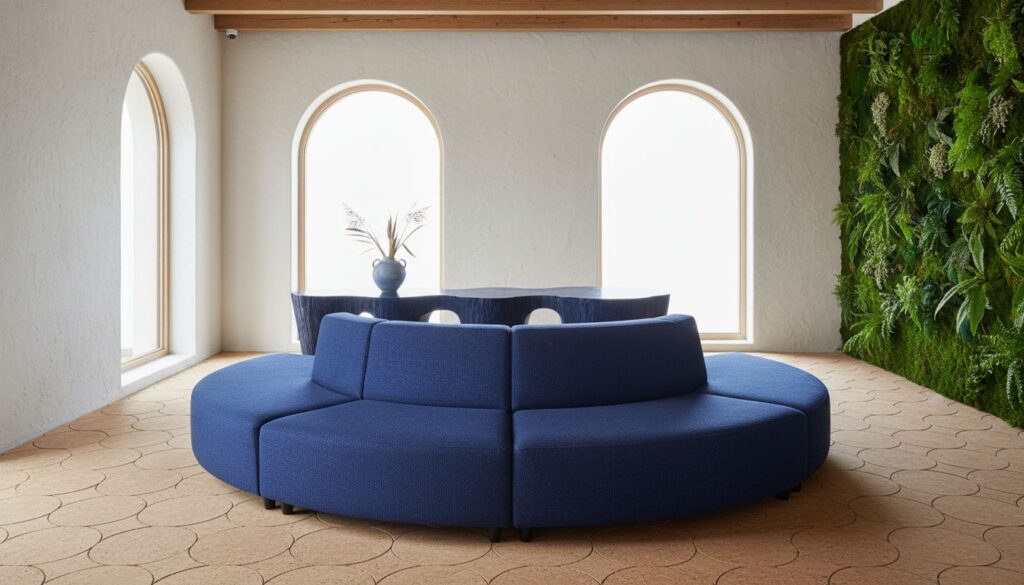
Resilient interiors are no longer defined only by durability, energy efficiency, or low embodied carbon. In 2026, the conversation has widened: interior resilience increasingly depends on whether furniture, finishes, and material systems can adapt, stay in use longer, and recover value through multiple life cycles. That shift is bringing circular furniture and regenerative materials to the center of design decision-making for architects, developers, and property owners who want spaces that perform under changing economic, environmental, and operational conditions.
Recent policy and industry guidance reinforces this direction. The Ellen MacArthur Foundation’s 2026 bio-based materials agenda frames wood, natural fibers, rubber, and leather not just as carbon-conscious choices, but as part of a broader resilience strategy tied to diversified supply chains, traceability, and circular design standards. At the same time, UNEP and LEED v5 are linking circular procurement, waste prevention, and material loops to a healthier, more resilient built environment. For project teams, that means the specification of furniture is becoming a strategic part of long-term interior performance.
Why resilience now includes circular furniture
For many years, furniture was treated as a relatively flexible layer of the interior: easy to purchase, quick to replace, and often disconnected from wider building resilience planning. That approach is changing. Circular furniture is now being understood as a system that helps interiors remain functional, serviceable, and economically viable over time by prioritizing maintenance, repair, refurbishment, remanufacturing, and eventual material recovery.
The FurnCIRCLE guide published in January 2025 explicitly describes circular transition in furniture as a way to create a more resilient system. This matters because resilience in interiors is not only about resisting damage; it is also about reducing exposure to supply volatility, replacement costs, waste disposal, and premature obsolescence. Furniture that can be repaired, updated, or reconfigured extends asset life and supports more agile responses to tenant changes, new uses, or budget pressures.
UNEP’s 2025 circular economy guidance makes a similar point at the urban and building scale, arguing that circular models enhance resilience, reduce costs, and help avoid linear lock-in. In practical interior terms, this means choosing furnishings and fit-out components that can circulate through multiple use phases instead of moving quickly from procurement to disposal. The result is a more stable material strategy for buildings that need to evolve without repeated resource loss.
From sustainable materials to regenerative and traceable inputs
The rise of regenerative materials marks an important evolution in sustainable interior design. Rather than focusing only on reducing harm, regenerative approaches aim to support systems that renew natural resources, strengthen local value creation, and build healthier material cycles. In furniture, this includes growing interest in bio-based inputs such as wood, agricultural fibers, hemp-based products, natural textiles, rubber, and responsibly sourced leather.
The Ellen MacArthur Foundation’s June 2026 policy agenda is especially significant because it frames bio-based materials as a resilience strategy, not just a carbon strategy. That reframing is highly relevant for interiors. Materials derived from diversified bio-based value chains can help reduce dependence on highly linear, fossil-intensive supply systems while opening pathways for local recirculation, repair industries, and skilled manufacturing. For project teams, resilience starts to include where materials come from, how well they are documented, and whether they can stay valuable after initial use.
Traceability is therefore becoming as important as sustainability claims. The built-environment conversation is moving beyond simply asking whether a material is recycled or renewable and toward whether it is transparent, separable, and supported by reliable composition data. For designers specifying circular furniture, traceable materials make future maintenance, component replacement, and end-of-use recovery more feasible. That transparency is also increasingly necessary for compliance, procurement standards, and credible sustainability reporting.
How circular furniture is shaping a new interior design language
Circular furniture is no longer only a back-end procurement strategy; it is becoming a visible design language. ArchDaily’s 2026 coverage of an open-plan project described a truly resilient interior as one where furniture can be disassembled, repaired, or returned without leaving a trace. That idea changes aesthetics as much as logistics. Interiors are beginning to value visible joinery, reversible fixings, modular forms, and finishes that age gracefully rather than conceal every sign of use.
This design language responds to time as a normal part of occupancy. Instead of treating wear, adaptation, and component replacement as failures, circular interiors anticipate them. Material palettes are increasingly selected to absorb use, change, and maintenance cycles while preserving the character of the space. For landlords, hospitality operators, workplace clients, and multifamily developers, this can support interiors that remain attractive even as furniture layouts and operational demands evolve.
There is also a practical planning advantage. When furniture is designed for disassembly and return, teams can reorganize open-plan environments, phase renovations more cleanly, and reduce disruption during churn. In measured survey and floorplan optimization workflows, this supports a more accurate alignment between layout strategy and furniture life cycle. Interiors become less dependent on one fixed moment in time and more capable of adapting through successive occupancies.
The business case: value retention beats replacement
One of the strongest arguments for circular furniture is economic resilience. A Journal of Industrial Ecology article on cascading use of wood furniture emphasizes that reuse, refurbishment, and other value-retention processes improve material efficiency and circularity more effectively than disposal-based models. In other words, the highest value often comes from keeping products in use, not from breaking them down after short service lives.
That logic is reinforced by a 2025 arXiv paper warning that narrow recycling metrics can miss the real resilience benefits of maintenance, repair, refurbishment, and remanufacturing. For owners and developers, this distinction matters. A chair with recycled content is useful, but a chair that can be repaired, reupholstered, upgraded, and redeployed across multiple projects can deliver greater long-term financial and operational value.
The same pattern is appearing in manufacturing and procurement strategy. EFIC’s position paper identifies reuse, refurbishment, remanufacturing, separability of parts, and responsible chemical use as core elements of circular product design. Furniture brands are also moving in this direction, with companies such as Keilhauer and Room & Board reporting growing focus on circular design guides, life-cycle analysis, bio-based inputs, and upcycled materials. Together, these shifts suggest that circular furniture is becoming a resilience toolkit for both producers and buyers.
Waste as feedstock: the growing role of recovered materials
Another major development is the increasing use of waste streams as valuable inputs for new furniture. A 2025 MDPI review found that increasing the share of waste materials in furniture can improve both environmental and economic performance. This is important because resilient interiors depend not only on what is durable, but also on what can be sourced more intelligently from existing material flows.
Textile waste is a particularly active area. A 2025 study in Building and Environment showed how discarded textiles can be transformed into new raw materials for upholstered seating while also improving acoustic performance indoors. That dual benefit is highly relevant for offices, hospitality spaces, education environments, and residential amenities where noise control is part of occupant comfort. It demonstrates that circularity can support performance outcomes rather than simply satisfy waste-reduction goals.
UNEP’s 2025 work on circular textiles points to the same broader opportunity: materials traditionally viewed as end-of-life burdens can become interior feedstocks. For specification teams, the implication is clear. Upholstery, acoustic elements, panels, and soft seating are increasingly viable platforms for recovered-content innovation. When supported by composition transparency and indoor-air-quality due diligence, these products can strengthen both material circularity and everyday spatial quality.
Adaptive systems for climate-resilient interiors
Resilience in interiors is also about the capacity to respond to climate-related pressures, changing occupancy patterns, and more fluid building use. A March 2025 MDPI case study on Urban Oasis describes modular, multi-sensory urban furniture as part of a transdisciplinary resilience approach for future climate adaptation. Although the study focuses on urban conditions, the principle translates directly to interior environments: furniture systems should help spaces adapt rather than force costly replacement.
Adaptive furniture systems can support flexible zoning, temporary density changes, acoustic control, and occupant well-being. In workplaces, this may mean modular seating and screens that can be reconfigured as team needs shift. In mixed-use or residential developments, it can mean amenity furniture that can be maintained and redistributed across spaces instead of being discarded when one area is refreshed. Circular furniture supports this by making adaptation technically and contractually easier.
Nature-based and bio-based materials also contribute to this resilience agenda when they are paired with responsible detailing and maintenance planning. Regenerative materials can support healthier tactile experiences, warmer visual character, and stronger links to biophilic design, while modular assemblies make future upgrades less invasive. The result is an interior approach that combines climate responsiveness, occupant comfort, and material longevity in one coordinated strategy.
Digital tools, material passports, and early-stage decision-making
The shift toward circular furniture and regenerative materials is being accelerated by better decision tools. A recent 2026 ScienceDirect paper on design-integrated circularity assessment highlights the value of digital tools and material passports in evaluating circularity during the earliest design stages. This is especially useful for project teams that need to compare layouts, furniture systems, and material options before procurement is locked in.
For architects and real estate professionals, early-stage circularity data can inform more than sustainability narratives. It can influence floorplan optimization, furniture density, maintenance planning, phased fit-outs, and future churn scenarios. When material passports document composition, disassembly pathways, replacement parts, and end-of-use options, they reduce the information gaps that often block circular outcomes later in the process.
These tools also address one of the key barriers identified by EFIC: limited supplier information on chemicals and material composition. In practice, resilient interiors depend on good data as much as good intentions. Measured surveys, accurate as-built models, and clear visualization workflows create a stronger foundation for specifying circular furniture systems that actually fit the space, perform as intended, and remain manageable over time.
What project teams should prioritize now
As circular furniture moves into mainstream interior practice, the specification brief needs to become more rigorous. Teams should ask whether a product can be disassembled, repaired, refurbished, remanufactured, or returned; whether the material inputs are bio-based, recycled, or regenerative; and whether composition and chemical information is sufficiently transparent. These questions align with LEED v5’s stronger focus on waste prevention and circular economy principles within a healthier, more resilient built environment.
It is also important to evaluate products according to realistic operational pathways. A beautifully designed circular chair is less useful if spare parts are unavailable, take-back logistics are unclear, or upholstery cannot be replaced without damaging the frame. Resilience depends on service models, documentation, and supplier commitment as much as on material innovation. That is why circular procurement should be treated as both a design task and a facilities strategy.
Finally, teams should balance ambition with constructability. EFIC notes that circularity in the furniture sector still faces practical barriers, including material complexity, substitution challenges, higher costs, and incomplete supplier data. The most effective approach is often phased: start with high-impact categories such as workstations, seating, tables, and acoustic elements; prioritize products with clear circular pathways and traceable material stories; and integrate those decisions into survey-based planning, visualization, and long-term asset management.
The most important takeaway is that circular furniture is no longer a niche sustainability theme. It is rapidly becoming part of how resilient interiors are conceived, specified, and managed. As research, policy, and market practice converge, the emphasis is shifting away from one-time material selection and toward continuous value retention, adaptability, and traceable resource flows. That change gives design teams a more robust framework for creating interiors that perform well through change rather than in spite of it.
Regenerative materials strengthen this shift by linking interior specification to wider ecological and economic resilience. When bio-based, upcycled, and repairable furniture systems are supported by accurate documentation, early-stage assessment tools, and flexible planning, they can help spaces stay useful, attractive, and resource-efficient for longer. For today’s architects, developers, and property owners, that is the real promise of resilient interiors: not only lower impact, but smarter long-term performance built into the furnishing layer from the start.