
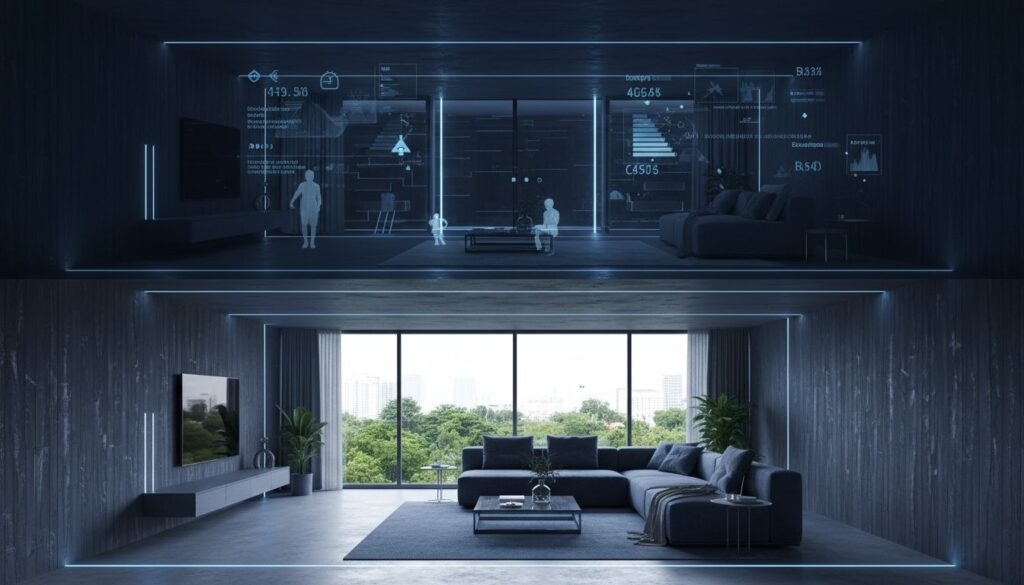
Property listings are changing shape. Instead of static photos and loosely described “recent upgrades,” the market is moving toward evidence: measurable space, verifiable performance, and visualizations that help buyers and tenants understand what they are actually getting.
Two forces are converging to accelerate that shift: AI-driven virtual twins that make buildings easier to capture, understand, and present; and low-carbon finishes that translate sustainability goals into tangible, specifiable choices. Together, they are reshaping how value is communicated,especially as investors and occupiers look for energy-smart, lower-risk assets.
1) From brochure-style listings to measurable, decision-grade listings
Traditional listings excel at aspiration, but they often fall short on clarity. Room sizes are approximate, layouts are implied, and finish descriptions are subjective. In a market where time-to-decision matters, that ambiguity creates friction.
At the same time, the wider real-estate sector is shifting toward more structured, machine-readable data. An arXiv paper from 2025 notes that the mandatory 2026 rollout of UAD 3.6 could accelerate AI use in valuation by moving reporting into structured formats,an important signal that listings, valuations, and underwriting are converging around standardized data.
For architects, developers, and agents, the practical implication is straightforward: the most effective listings are increasingly those that can be verified,dimensions, layout logic, daylight and circulation, and the specification narrative behind finishes and upgrades. The listing becomes a compact “project brief” that supports faster, more confident decisions.
2) AI adoption is real,but value is coming from targeted workflows
AI in real estate has moved beyond novelty, but execution is still uneven. JLL’s 2025 Global Real Estate Technology Survey found that 88% of investors, owners, and landlords had started piloting AI, while only 5% said they had achieved all AI goals. On the occupier side, 92% were also running AI pilots.
That gap between experimentation and outcomes matters. It suggests that the winners will not be the firms with the most “AI features,” but the ones that choose a few high-impact workflows and implement them end-to-end,capture, modeling, content production, and performance storytelling.
In listings, those targeted workflows tend to include: automated measurement and layout extraction, generation of clear plan graphics, consistent photo and tour labeling, and the ability to create variants of a space (staged vs. unstaged, current vs. proposed). When these steps are integrated, the listing becomes more accurate, faster to produce, and easier to compare.
3) AI-driven virtual twins: a new baseline for spatial truth
“Virtual twin” building models are not new,McKinsey has described 5-D BIM and virtual twins as tools that help create a “virtual twin” of physical projects and support delivery on budget, on time, and on spec. What is changing is how accessible these models have become for marketing, refurbishment planning, and ongoing asset decisions.
In property marketing, digital twin concepts are now common in commercial products. Matterport, for example, positions its platform as having “reinvented the virtual tour,” adding AI features for property intelligence and automated measurement/layout workflows. In parallel, some listing vendors are bundling 3D tours, analytics, and AI content tools,combining hosted viewers, branded links, performance metrics, and AI writing support.
For listings, the essential leap is that a virtual twin anchors the narrative in geometry. When the model is created from a measured survey and checked against site conditions, it reduces downstream errors: mismatched room counts, misleading circulation, and “optimistic” dimensions. In turn, that precision supports more credible floorplan optimization proposals and more reliable cost planning for refurbishment.
4) Interactive finish switching turns “taste” into testable options
The most persuasive listings don’t just show what exists,they help prospects understand what could exist. Increasingly, visualization vendors market interactive digital twins that allow users to instantly switch finishes, colors, and even layouts inside a model, with the goal of improving buyer confidence and speeding decisions.
This capability is particularly useful in refurbishment and developer-led repositioning. A buyer viewing an older apartment can test a warmer timber floor against a mineral paint palette, or compare matte and satin joinery finishes, without relying on imagination. For a landlord, it can demonstrate how a standard kit-of-parts upgrade would look across multiple units, supporting portfolio-wide consistency.
Critically, interactive options are most effective when they are curated. A tight set of finish families,aligned to durability, maintenance, indoor air quality considerations, and embodied-carbon priorities,creates clarity rather than distraction. The digital twin becomes a decision tool, not a gimmick.
5) Low-carbon finishes bring embodied carbon into the listing conversation
Decarbonizing buildings remains one of the largest available levers. McKinsey states the real estate industry accounts for about 40% of global combustion-related emissions, with 28 percentage points from building operations and 12 from embodied carbon in materials and construction. That split is important: even if operational energy improves, materials still matter,especially in retrofit-heavy markets.
Low-carbon finishes sit within that embodied-carbon slice. They rarely attract as much attention as HVAC or façade upgrades, but finishes are replaced more frequently and are highly visible in the user experience. Thoughtful choices can reduce emissions while improving wellbeing, durability, and maintenance cycles.
In listing terms, this creates a new type of spec narrative: not just “new kitchen,” but “new kitchen with low-VOC coatings, responsibly sourced timber veneer, recycled-content worktops where feasible, and design detailing that supports repair.” The finish story becomes part of the building’s performance story,tangible, comparable, and increasingly valued.
6) “Energy-smart” upgrades are now value protection, not just virtue
Market messaging is shifting toward energy-smart and low-carbon asset upgrades. JLL said in September 2025 that the business case for low-carbon, energy-smart strategies is strengthening as obsolescence risk rises and occupier demand shifts. In other words, sustainability is moving from a differentiator to a baseline expectation in many segments.
Listings that communicate this well do two things: they describe the upgrade, and they translate it into reduced risk and improved comfort. Better airtightness and glazing are not just line items,they can mean fewer drafts, better acoustic performance, and more predictable running costs. Efficient systems support comfort with less volatility.
The role of finishes here is often overlooked. A listing that pairs energy upgrades with robust, low-carbon interior specifications signals a coherent strategy rather than a superficial refresh. For buyers and tenants, coherence reduces uncertainty: the building has been improved systematically, not cosmetically.
7) Digital twins as a workflow tool: from viability to operations
Digital twins are being positioned explicitly as a real-estate workflow tool. McKinsey notes that digital twins, paired with advanced analytics and gen AI, can improve project viability assessments and operating decisions. This matters because the listing phase is not isolated; it sits within a chain of feasibility, delivery, leasing, and ongoing management.
McKinsey’s March 2026 real-estate outlook also highlights the push toward more data-driven operating models, where agentic AI can centralize and structure lease and performance data, automate recurring analyses, and surface early warning signals. In practice, that means the “listing dataset” increasingly feeds downstream decisions,capex planning, lifecycle costing, and ESG reporting.
When a virtual twin is maintained beyond marketing, it becomes a living reference: a place to track planned upgrades, record material choices, and link to O&M data. That continuity supports better decision-making and reduces the costly rework that comes from recreating models and drawings at every project stage.
8) Retrofit, circularity, and the listing narrative buyers now expect
Retrofitting is critical to decarbonization. McKinsey’s February 2025 retrofit research says the built environment is responsible for almost 40% of global energy-related CO₂ emissions, and that retrofitting is essential. For older stock competing against newer, more efficient buildings, retrofit strategy is now a core part of market positioning.
Circular, lower-carbon retrofit strategies are also gaining traction. McKinsey links circular approaches to carbon abatement and net value gain, and notes that design for disassembly can enable material recirculation. For interiors, this can translate into reuse-ready detailing, salvage and refurbishment of existing elements, and material selections that avoid unnecessary complexity.
Forward-looking listings can reflect this without becoming technical reports. A clear, plain-English summary,what was retained, what was replaced, why those materials were selected, and how future replacement can be handled,signals quality. It also aligns with a broader market narrative that increasingly rewards “AI + sustainability” rather than treating them as separate themes.
AI-driven virtual twins and low-carbon finishes are not just new tools and new materials; they represent a different standard of proof. As structured data becomes more common and AI moves from pilots into targeted workflows, listings will increasingly function as decision-grade documents,grounded in measurable space and credible specifications.
For design-led teams, this is an opportunity to communicate value with precision: a virtual twin that clarifies layout and potential, paired with a finish strategy that supports lower embodied carbon, durability, and wellbeing. In a market shaped by energy-smart expectations and rising obsolescence risk, that combination helps properties stand out for the right reasons,clarity, performance, and long-term resilience.